AI is moving quickly, and for most B2B tech businesses it’s already part of how work gets done. It’s built into the tools teams use and shaping how outputs are created.
That doesn’t mean the exploration phase is over. It just means expectations have shifted.
Content production is moving faster. Teams are experimenting more. In some cases, there are early signs of efficiency gains.
But for many organisations, especially those scaling quickly, there’s still a gap between adoption and real impact. Access to AI is no longer the challenge. Knowing how to use it well, consistently and with confidence is where things become more challenging.
Why this matters now
In complex B2B environments such as data centres and infrastructure, the context is very different to more transactional markets. Sales cycles are longer, deals are higher in value, and decisions often involve multiple stakeholders with different priorities.
In that environment, speed alone isn’t enough. Consistency, accuracy and trust matter just as much.
AI can support all three. But without enough structure around how it’s used, it can just as easily create inconsistency or risk. The difference comes down to how deliberately it’s applied.
Start with the work, not the tools
Most AI journeys still begin with technology. New platforms are introduced, teams are encouraged to explore, and usage tends to increase quickly. What doesn’t always follow is a meaningful shift in outcomes.
This is a familiar pattern across B2B organisations. The challenge is rarely access to tools, but aligning those tools to real work.
A better starting point is to look at where time is actually being spent. Where are tasks repetitive? Where does output vary depending on who’s doing it? Where is work being duplicated or reworked?
These are the areas where AI tends to add the most value. Not through large transformation programmes, but by removing friction and improving consistency in the day to day.
Focus on a small number of use cases
A better starting point is to look at where time is actually being spent. Where are tasks repetitive? Where does output vary depending on who’s doing it? Where is work being duplicated or reworked?
These are the areas where AI tends to add the most value. Not through large transformation programmes, but by removing friction and improving consistency in the day to day.
Treat AI as part of the team
One of the most useful shifts is to stop seeing AI purely as a tool and start treating it as part of the workflow.
In practice, it works more like a junior member of the team. It can help structure information, get you started and move work forward more quickly. But it still needs direction, context and review.
AI outputs can be convincing, but they’re not always right. When it doesn’t have enough context, it will often fill the gaps with something that sounds plausible. That’s where risk comes in.
The simplest way to manage this is to assume the first output is a draft, not an answer. Challenge it. Ask it to explain its reasoning. Cross-check anything that matters.
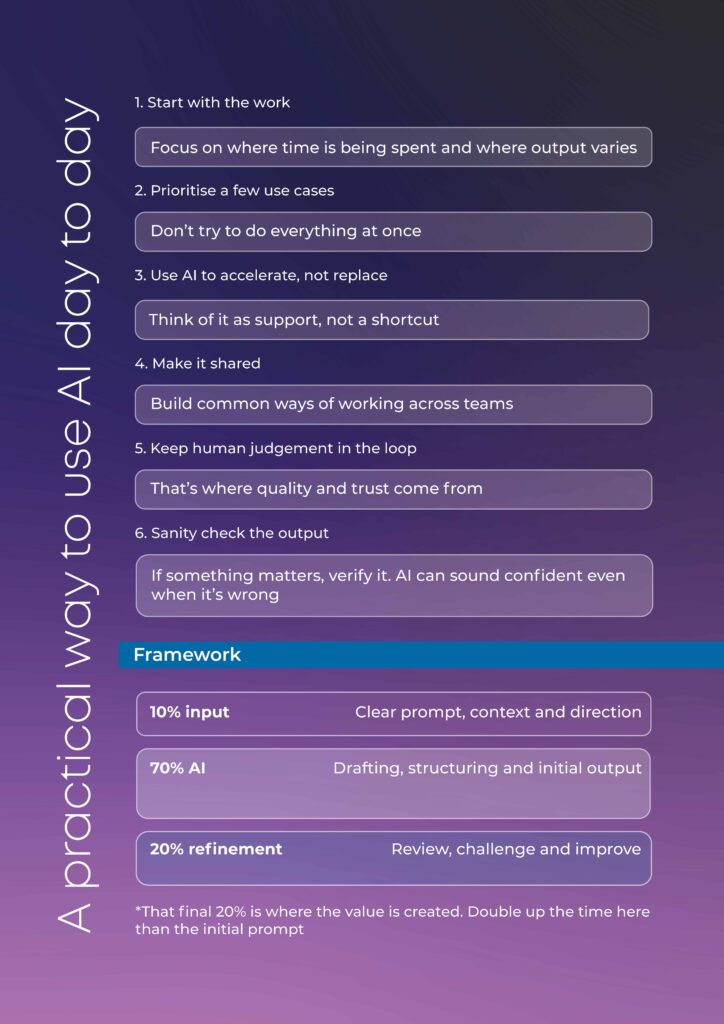
A simple way to think about it:
10% input – your initial prompt, context and direction
70% AI support – the draft, structure and heavy lifting
20% refinement – reviewing, QA and improving the output
That final 20% is where the real value sits. It’s where quality, judgement and experience come through.
A good way to benchmark this is it should be taking you double the time of the initial prompt. The output only becomes useful once it’s been properly challenged and refined.
Make it a shared capability
As AI use grows, it starts to influence how knowledge moves through the business.
If it stays with individuals, it remains a productivity tool. Useful, but limited. When it’s shared, it becomes far more valuable.
Teams begin to align around common ways of working. Outputs become more consistent. Knowledge is less dependent on individuals and more embedded across the organisation.
That shift comes from sharing prompts, approaches and learnings, and giving people the space to test and improve how they use AI in practice.
Adoption doesn’t come from strategy documents. It comes from people using it in their day-to-day work.
Be clear on how you want to use it
As AI becomes more embedded, most businesses reach a point where they need clarity around how it should be used.
This doesn’t need to be overly complex. But it does need to be intentional.
This is where many businesses are starting to take a more deliberate approach, often through the creation of an AI manifesto. Not as a restrictive policy, but as a shared set of principles that guide how AI is applied across the organisation.
It helps answer important questions. What role should AI play in the business? Where are the boundaries? How do you ensure outputs reflect your brand, your standards and your thinking? And where does human oversight need to stay in place?
Answering these questions builds confidence and consistency, it aligns AI with culture, rather than allowing it to operate independently of it.
It also ensures AI supports what makes the business distinctive, rather than diluting it
Staying human – that’s the advantage
AI makes it easier to produce content, ideas and outputs at speed. It lowers the barrier to getting started.
But in doing that, it also raises expectations.
Clarity of thinking matters more. Judgement matters more. Trust matters more.
In B2B environments where decisions are larger & more complex, that shift is important. The advantage doesn’t come from using AI more aggressively. It comes from using it more deliberately.
The organisations that stand out will be the ones that combine efficiency with real insight, context and experience.
Because when content is easy to generate, what stands out is what feels real.
Getting started
For most organisations, progress doesn’t come from large-scale transformation. It comes from focus.
Starting with a small number of use cases, testing them properly, refining what works and sharing those learnings across teams creates a far more sustainable path forward.
Over time, this builds a more consistent and confident approach to AI – one that evolves with the business rather than disrupting it.
Final thought
AI is already part of how B2B businesses operate.
What matters now is how intentionally it’s used.
The difference won’t come from access to the technology. It will come from how well it’s built into the way your organisation thinks, works and makes decisions, while keeping the human layer firmly in place.